Jiří Filip
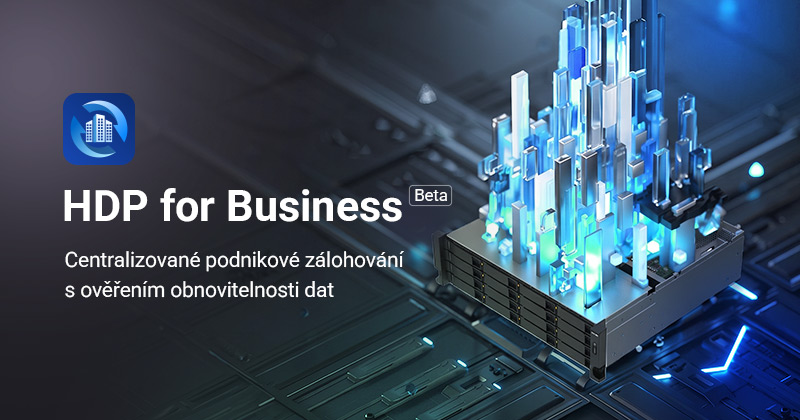
QNAP® Systems, Inc. is introducing a new feature that will make it much easier for businesses to back up and restore critical data. It has introduced a beta version of an enterprise solution GDP for Business, which can turn existing QNAP NAS servers into comprehensive backup centers. The innovation responds primarily to the increasing number of ransomware attacks and increasingly complex corporate IT infrastructure, which often combines physical servers, virtual machines and cloudservices. The advantage is the ability to use existing hardware, thus avoiding the costs of purchasing specialized backup devices.
As pointed out by QNAP product manager Jack Wang, the mere existence of backups does not guarantee that they will be able to restore company systems in the event of problems. That is why HDP for Business offers automatic verification of data recoverability, which is also supplemented by video recording of the entire process. This gives IT departments a clear overview of whether backups are actually functional, as well as evidence that can be used in security audits.
All important backups under one roof
One of the main goals of the new solution is to eliminate backup fragmentation in the corporate environment. HDP for Business can work with a wide range of platforms that businesses commonly use. VMware® virtual machines are supported, Microsoft® Hyper-V and Proxmox®, computers and servers with Windows®, but also Nutanix®, Net file storageApp®, QNAP NAS or systems communicating via SMB and rsync.
There is also the option to back up Oracle® databases and Microsoft® SQL Server. This allows administrators to integrate different parts of the infrastructure into a single platform, rather than having to use a different tool for each type of device. The result is simpler configuration, clearer control of backup tasks, and less work on day-to-day administration.
Ransomware should have the most difficult path to backups
Security is one of the most important features of HDP for Business. That's why QNAP has opted for a combination of several protection mechanisms to prevent attackers from damaging or deleting backed up data.
- Immutable backup: The QuTS hero operating system allows you to lock created backups for a predetermined period of time. During this period, they cannot be edited or deleted, even with adminiwith administrative permissions.
- Airgap+: The technology automatically isolates backup servers outside of scheduled backup intervals, limiting the possibility of malware spreading through the corporate network reaching them.
- Pravidlo 3-2-1-1-0: The solution works with local storage QuObjects, cloudby email service myQNAPcloud Object and other S3-compatible platforms, such as Amazon® S3 and Wasabi®, allowing companies to create remote immutable copies and continuously check their recoverability.
Restore systems in minutes
HDP for Business focuses not only on data storage, but also on its actual usability. After the backup is completed, it can automatically perform a recovery test and start the backed up system. Everything happens directly on the backup server, so there is no need to interfere with the production infrastructure. The process also includes video recording, which can serve as proof of successful backup verification.
If one of the company's servers stops working,miniPlayers can use the Instant RestoreThis allows you to run the backed up environment as a virtual machine directly on the backup server. This means that critical services can be restored within minutes without having to wait for a complete restore of the original device.
Easier branch management and more favorable licensing
QNAP also thought of companies that operate multiple offices or data centers. HDP for Business offers a central console to monitor and manage backups across multiple locations. If the main management server fails, it is possible to switch to the backup server and keep scheduled backup jobs running.
Another significant advantage is the absence of licensing fees for individual protected servers and virtual machines. HDP for Business is installed directly on compatible QNAP x86 NAS devices and uses their existing computing power and storage capacity. Only the centralized management function is charged.
The beta version currently supports deployments of up to four QNAP NAS devices, including a management server and backup nodes. With the release of the final version, the manufacturer plans to expand licensing options for larger installations.
Where to get HDP for Business and what you will need
The new solution is already available in beta via QNAP App CenterIt initially runs on QuTS hero operating system version h6.0.0 and later, with QTS support to be added gradually.
From a hardware perspective, a QNAP NAS with an Intel® or AMD® x86 architecture processor is required. The device acting as the management server must have miniAt least a quad-core processor and 8 GB of RAM. Other compatible NAS servers can be used as backup nodes. QuTS hero is required for non-volatile backup, while Instant Restore and automatic backup verification require Virtualization Station.
For details on supported platforms, features, and deployment options, please visit the official QNAP HDP for Business website.